Access Rights
An event file always belongs to a single customer account, and only the account owner can access the access rights settings for security reasons.
Through the access rights you can grant access to another RACE RESULT account either by username or customer ID, you can additionally control the access to certain areas of the software for that specific event by clicking the Edit Icon.

Simple API
The Simple API serves to make data from your event file accessible through a static link without logging in to your customer account, this may be to publish results on another website.
Settings can be accessed through Basic Settings ⇒ Access Rights/Simple API. Simply select what type of data you would like to make accessible and then select the list name or enter the setting name. The details for each API type are below.

The icon in the column Link then leads to the static link.
When calling APIs you should consider that they will be cached for between 10-30 seconds, therefore calling them more often may not result in data updating correctly.
The Simple API applies rate limiting of 1 call per second per each unique API URL from each unique address. If your client script is calling an API more than once per second then it will receive a 406 error code. If you require more frequent calls please contact support.
Lists API
The List API takes any Output Lists you have already created and serves it via a static link. You can select the format of the list in the setup or append the format to the end of the URL.
Output Formats
Standard: TXT, HTML, PDF, CSV, XML, XLSX (Excel)
Developer Focused: JSON, JSON ext (includes full formatting/CSS data from the output settings)

Potential Use Case: If you have a "Live Results" output list, you can provide the JSON link to a broadcast to display live results.
Statistics API
The Statistics API provides a snapshot of the Statistics (e.g., finisher counts by gender, t-shirt size totals) defined in the Statistics tab.
Formats: PDF or XLS.

Potential Use Case: Providing a "live-updating" Excel link to the race announcer or the medical tent so they can track the percentage of participants currently on the course versus those who have finished.
Settings API
The Settings API type allows you to retrieve specific event-level configuration data. To use this, select Settings as the Type and enter the specific setting name you wish to retrieve.
The following fields can be called via the Settings API:
Basic Event Settings
| Field | Setting Location |
| EventName | Name of Event |
| EventDate | Event Date From |
| EventDate2 | Event Date To |
| EventLocation | Event Location City |
| EventZip | Event Location Zip Code |
| EventCountry | Event Location Country |
| EventStreet | Event Location Street |
| EventLogo | Main Event Settings Logo |
| SpecialDateFormat | Localization Settings Special Date Format |
Dashboard Summary
| Field | Setting Location |
| OverviewNotes | Dashboard Summary - Notes |
| OverviewContact | Dashboard Summary - Contact Information |
| OverviewTodos | Dashboard Summary - ToDo List |
Derived Settings
| Field | Setting Location |
| PortalID | Event ID |
| PortalPublishEvent | Activate myraceresult.com Publish Event Checkbox |
| LastDataAnalysis | Last time Participants ⇒ Data Analysis ran |
| EventLocationLat | Latitude of Event Settings Location |
| EventLocationLng | Longitude of Event Settings Location |
The list of fields should be comma separated without any spaces.

Potential Use Case: This is particularly useful for synchronizing event metadata with external websites or mobile apps without manual entry. Automatically displaying the official race name on a website showing upcoming events.
Counter API
The Counter API is a lightweight call designed to return a single integer: the number of participants. The API can return the total participants in the event or a particular contest.

Potential Use Case: Powering a "Registration Counter" on a website homepage that shows "Only X spots left!" by subtracting this API value from your race capacity.
Custom APIs
Custom APIs allow for further refinement of API outputs and also provide some additional functionality when working with RACE RESULT 14.
This guide will document some of the functionality that can be achieved with custom APIs, but should you have any further specific requirements then please contact support with your requirements.
RaceMap Access
To link the participants data of your event file to Racemap, you need to use the simple API feature under Basic Settings ⇒ Access rights / Simple API
In the Type setting, select "Racemap Access".
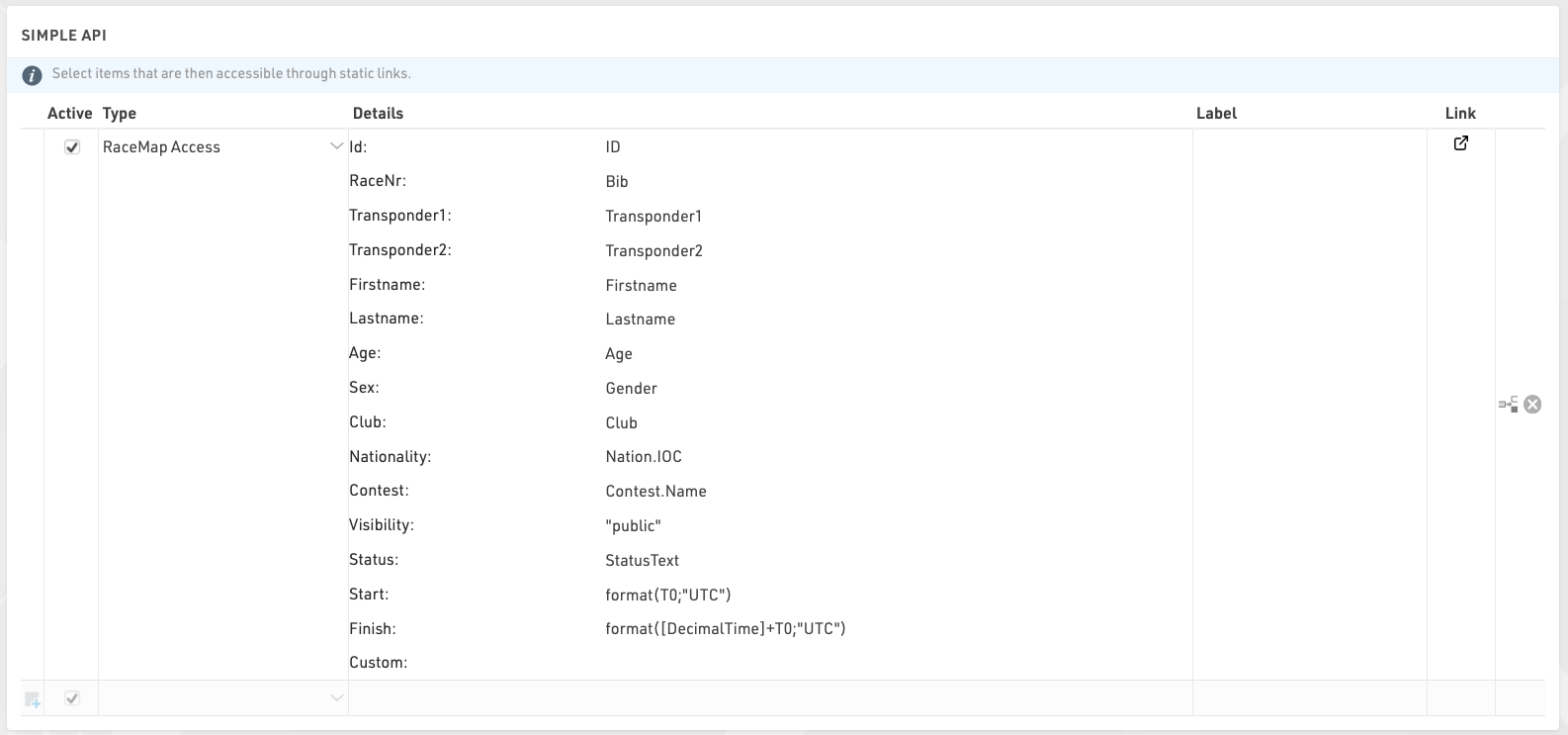
An integration is automatically created, with the default settings above. These should be fine for most events, but you can edit them where needed.
Here is more information about each field, and what you should put in them:
- Id: should contain a numerical value that is unique through the event file and does not change.
- RaceNr: that field will be displayed on each participant's flag in the timing visualisation. It is typically the bib number, but can be anything you like (it can even include text and emojis) and does not need to be unique.
- Transponder1 and Transponder2: chip codes assigned to a participant via the corresponding data fields. If you are using a chip file instead of these two fields to assign chips, replace Transponder1 with TransponderInChipFile in the Transponder1 field.
- Contest: typically, the contests are as set up in the event file. However, you can use this field to group participants into any categories relevant to Racemap, for example if participants from a given contest do not all perform the same course.
- Visibility: leave as "public" so participants show up in the Racemap
- Start and Finish: needs to contain the start and finish time of day (in UTC time) of the participants, or be left blank. When filled, Racemap uses these fields to ignore trackpings before / after a participant is on course, so it is critical that they are properly set up, or blank.
- Custom: use this field to add any extra information. You will need to liaise with Racemap to make sure they can actually make any use of what you put there.
Webhooks
RACE RESULT 14 can send webhooks upon certain triggers, these are predominantly used to ensure the synchronization of data between 2 separate data stores, for example if you are using your own registration platform and want to ensure participant data is updated if it is changed in the Event File.

Webhooks are configured under Basic Settings ⇒ Access Rights / Simple API.
Each webhook needs to define the trigger, the destination URL, and for certain triggers a filter and fields can be defined.
When setup and activated the webhooks will automatically be sent according to the triggers defined, there is no time limit to how long webhooks will be activated for.
All webhooks are sent as a POST request with data in the POST body as JSON, by default the body will always contain Event ID, Webhook ID, Timestamp, additional values depend on the trigger being used.
A call is considered successfully sent if a response code <500 is received, even if the status code is an error code it is still considered received by the destination. If a call is unsuccessful then the server will attempt to resend it with an increased delay between or until the Server queue limit is reached at which point the message will be dropped.
Webhooks are sent by the SES which is running the event file, if you are timing offline, even with online forwarding enabled, the webhooks will only be sent by your local SES.
Triggers
New Participant
A call will be sent when a new participant is added, this can be either through import participants, online registration, on-site registration or directly through the participants window.
A filter can be applied to only send the webhook if a certain filter is true, for example if a participant has selected a specific option during registration.
The post body can also include any fields which are defined as a list of semi-colon separated values.
Participant Update
Similar to the new participant trigger the participant update will send whenever the data fields of a participant record are changed, this will not be triggered by changes to Splits, Results calculations or User-Defined Fields.
A filter can also be applied to participant updates and the post body can be configured to include fields as well.
New Raw Data
The new raw data trigger will be sent whenever a new raw data record is added, the record is linked to a participant record so you can optionally define a filter and fields to be included in the POST body.
When using the New Raw Data it is recommended to link the filter to a specific result or the Finish result, for example - only send the webhook if the participant is Finished. Any calculations which depend on the raw data record will be completed first so it will send even if that time is used for the specific result you are looking at.
Settings Changed
This applies to any event file settings which are changed, this includes for example all Event, Chip Timing and Scoring settings, updates to Output Lists, my.rr settings and more.
Since the settings apply to the Event file and not a participant record it cannot be filtered or include additional fields. The Post body will include the ModJobID in the Values field to allow you to track the changes.
The ModJob ID is an integer which represents the last calculation cycle run by the SES. Whenever something is changed in an event file a unique job is run which calculates what should be updated in the database. This ID will increase for every change no matter how big or small.
All Changes
All changes means any change to the event file.
Since the all changes applies to the Event file and not a participant record it cannot be filtered or include additional fields. The Post body will include the ModJobID in the Values field to allow you to track the changes.